From Theory to Robotics: How InovTech and UEW Prepared 105 Ghanaian Teachers for Technology-Integrated Learning
A university partnership, 105 educators and one urgent question: how can robotics make mathematics, science and ICT more practical in Ghanaian classrooms?
The central idea
This case study shows how institutional partnership, practical learning and follow-up support can move teacher training beyond a one-day technology demonstration.
Editorial evidence note
External sources are linked below. InovTech-specific facts are limited to what those sources or the organisation’s verified records support.
How a Ghanaian institution could apply this guide
Imagine a leadership team using the five decision areas in this article before committing funds. Instead of beginning with a preferred product, the team defines learner outcomes, checks readiness, requests comparable evidence and pilots the highest-risk assumption. That process creates a defensible decision and gives InovTech—or any provider—a clearer standard to meet.
Why this decision matters
For universities, municipalities, school groups and teacher-development partners, the decision affects educational quality, finances and trust. Teachers are frequently expected to integrate coding and robotics without enough equipment, rehearsal or connection to the subjects they already teach.
This case study shows how institutional partnership, practical learning and follow-up support can move teacher training beyond a one-day technology demonstration. The aim is not to rush the reader toward a purchase; it is to make the requirements for a strong decision unmistakably clear.
The partnership and the educational challenge
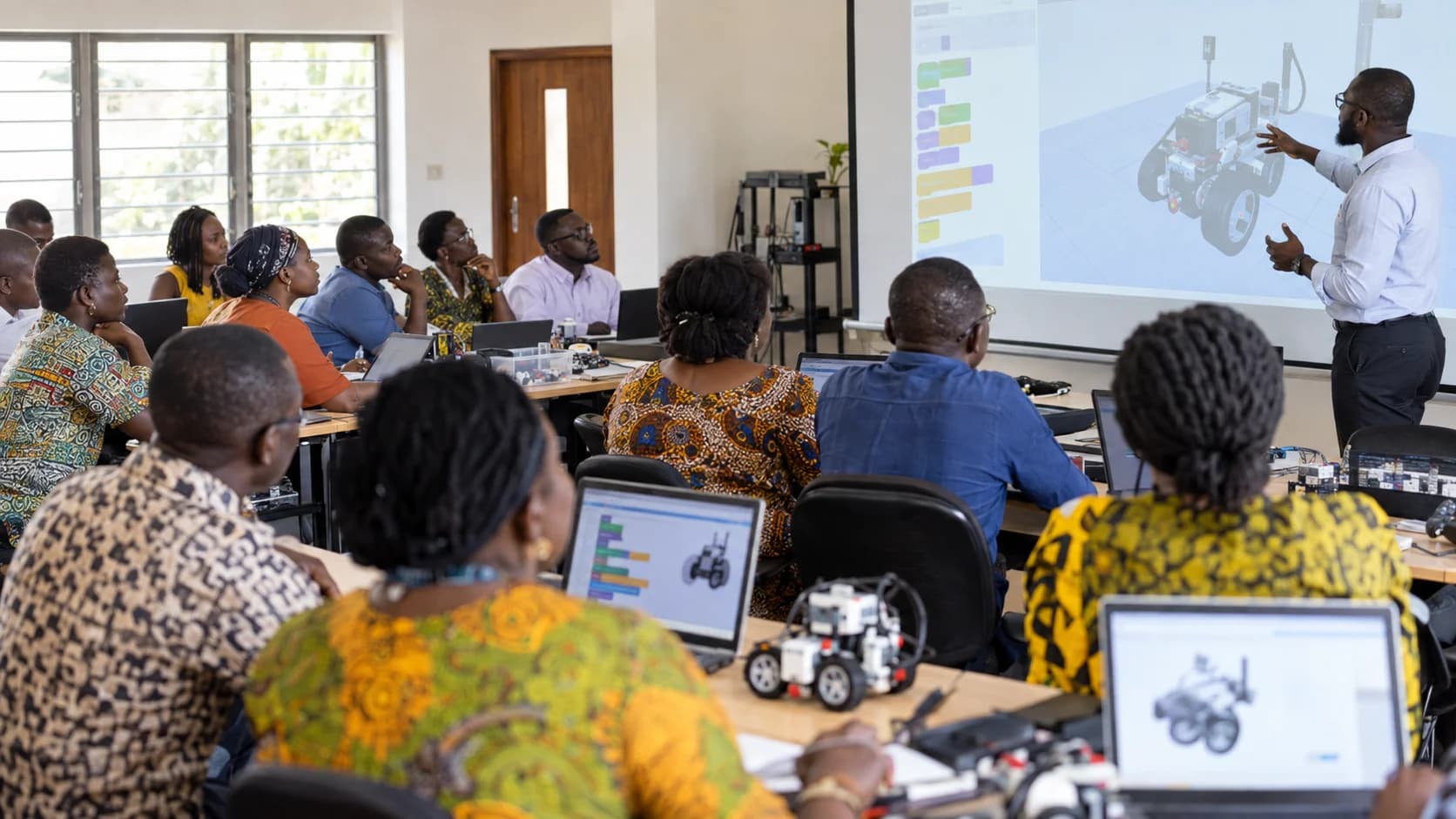
On 30 September 2025, the Centre for School and Community Science and Technology Studies at the University of Education, Winneba collaborated with InovTech STEM Center to train educators from the Effutu Municipality. The official UEW account records 105 participants: 90 teachers from public basic schools and 15 from private schools, representing mathematics, science and ICT.
The practical question is whether this principle is visible in plans, budgets, learning materials and day-to-day responsibilities. Institutions should ask for evidence, test assumptions on a manageable scale and document who owns the next action.
Why robotics became the connecting language
The programme positioned robotics as a practical meeting point for disciplinary knowledge. Concepts such as measurement, geometry, sequence and cause-and-effect became decisions inside a functioning system rather than facts isolated on a page.
The practical question is whether this principle is visible in plans, budgets, learning materials and day-to-day responsibilities. Institutions should ask for evidence, test assumptions on a manageable scale and document who owns the next action.
How KodeVR reduced the access barrier
Teachers explored KodeVR as a mobile-first virtual robotics environment designed in Africa. Virtual access allowed participants to practise coding, simulation and debugging without requiring a complete physical robot for every teacher.
The practical question is whether this principle is visible in plans, budgets, learning materials and day-to-day responsibilities. Institutions should ask for evidence, test assumptions on a manageable scale and document who owns the next action.
The difference between exposure and capability
The workshop blended explanation with practice and was connected to a mentorship approach with school-based follow-up. That distinction matters: exposure can inspire, but capability requires application, feedback and another opportunity to improve.
The practical question is whether this principle is visible in plans, budgets, learning materials and day-to-day responsibilities. Institutions should ask for evidence, test assumptions on a manageable scale and document who owns the next action.
What another district or school group can replicate
A replicable programme begins with subject-linked outcomes, prepares facilitators, creates device and connectivity contingencies, collects evidence during training and schedules follow-up before the initial workshop ends.
The practical question is whether this principle is visible in plans, budgets, learning materials and day-to-day responsibilities. Institutions should ask for evidence, test assumptions on a manageable scale and document who owns the next action.
Your practical next step
Request a teacher-development programme designed for your institution, municipality or school network. A useful first conversation should clarify learners, objectives, location, timetable, current capacity, constraints and the evidence required for a decision.
InovTech can then recommend an appropriate pathway rather than forcing every institution into the same package.
- Define subject-specific integration goals
- Group teachers by practical implementation need
- Use physical and virtual robotics strategically
- Plan school-based mentorship
- Track what changes in lessons
Frequently asked questions
How many teachers participated in the UEW and InovTech programme?
UEW’s official report records 105 teachers: 90 from public basic schools and 15 from private schools.
Can InovTech adapt this training for another institution?
Yes. The delivery model can be adapted to teacher numbers, subjects, infrastructure, geography and the level of post-training mentorship required.
Put the article into practice
- 1Define subject-specific integration goals
- 2Group teachers by practical implementation need
- 3Use physical and virtual robotics strategically
- 4Plan school-based mentorship
- 5Track what changes in lessons