Africa Does Not Need More Technology Consumers. It Needs Young Builders.
The decisive question is no longer whether African learners can use technology. It is whether they can understand, shape and build the systems defining their future.
The central idea
Digital access matters, but Africa’s real advantage will come from learners who can investigate problems, engineer solutions and turn ideas into useful systems.
The most important divide is no longer access versus no access
A learner can spend years surrounded by screens and still remain outside the world of invention. Watching videos, navigating apps and completing digital quizzes may build familiarity, but familiarity is not technological agency. Agency begins when a young person can ask how a system works, test an idea, find an error and improve a design.
That distinction should shape the next era of education in Ghana and across Africa. The continent does not merely need more users of technologies designed elsewhere. It needs confident builders who can adapt tools to local realities—from agriculture and health to transport, climate resilience, manufacturing and public services.
Robotics is not really about robots
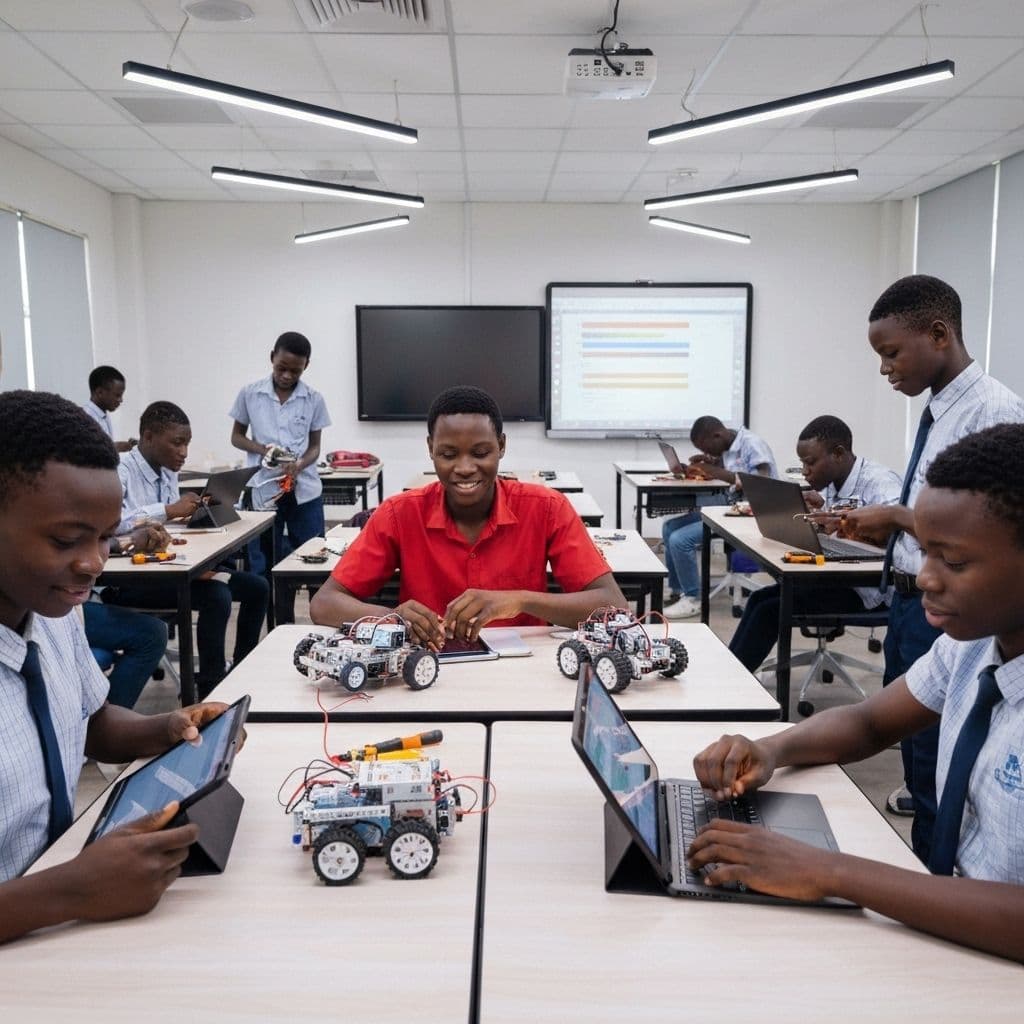
A well-designed robotics lesson is a compact encounter with the real world. A learner must combine mechanics, electronics, computation, measurement, teamwork and communication. The robot makes thinking visible: if the instructions are vague, the machine behaves vaguely; if the structure is unstable, the design fails; if the team cannot explain its choices, improvement slows.
This is why robotics belongs in serious education strategy rather than in the category of occasional entertainment. It creates a safe environment in which failure becomes information. Learners discover that intelligence is not the absence of mistakes—it is the ability to diagnose, adapt and try again with better evidence.
- Build before memorising
- Debug before giving up
- Explain before claiming success
- Collaborate before competing
The classroom must connect to African problems
Imported examples can introduce a concept, but relevance turns that concept into purpose. Students should be invited to design around the environments they know: water use, waste, road safety, energy reliability, accessibility, food systems and community information. These challenges are not limitations; they are an extraordinary curriculum.
Contextual learning also changes who sees themselves as an innovator. When a project begins with a familiar problem, learners bring lived knowledge into the room. Technical skill and community insight meet. The result is not only stronger engagement but a more inclusive definition of expertise.
What schools should demand from a STEM partner
Equipment alone is not transformation. A credible STEM partner should be able to explain the learning progression, prepare teachers, protect learners, maintain systems, assess real capability and show how a programme can continue after the excitement of launch day.
InovTech’s approach connects these pieces: hands-on programmes, laboratory planning, teacher development, portable kits, robotics pathways and virtual learning through KodeVR. The aim is not to place technology in a school. It is to build a learning system around it.
- Clear learning outcomes
- Teacher capacity and coaching
- Safe, inclusive participation
- Evidence of learner growth
- A realistic sustainability plan
The builder generation is already here
Africa’s young people do not lack imagination. Too often, they lack repeated opportunities to turn imagination into tested work. Give a learner one demonstration and you may create excitement. Give that learner a progression of meaningful challenges, skilled guidance and room to iterate, and you begin to create capability.
The future will not be secured by teaching children to admire innovation from a distance. It will be shaped by schools and communities courageous enough to let them build it.
Frequently asked questions
Why teach robotics in Ghanaian schools?
Robotics integrates science, mathematics, coding, design and teamwork in a practical format that makes learner thinking visible and develops problem-solving capability.
Does a strong robotics programme require expensive equipment?
No. Schools can begin with low-cost physical activities, shared kits or virtual robotics, then expand equipment as teacher capability and learner demand grow.