Robotics Curriculum for Schools: What Students Should Learn at Every Age
A robotics curriculum should feel like a staircase, not a box of disconnected challenges. Every stage must prepare learners for the reasoning demanded by the next.
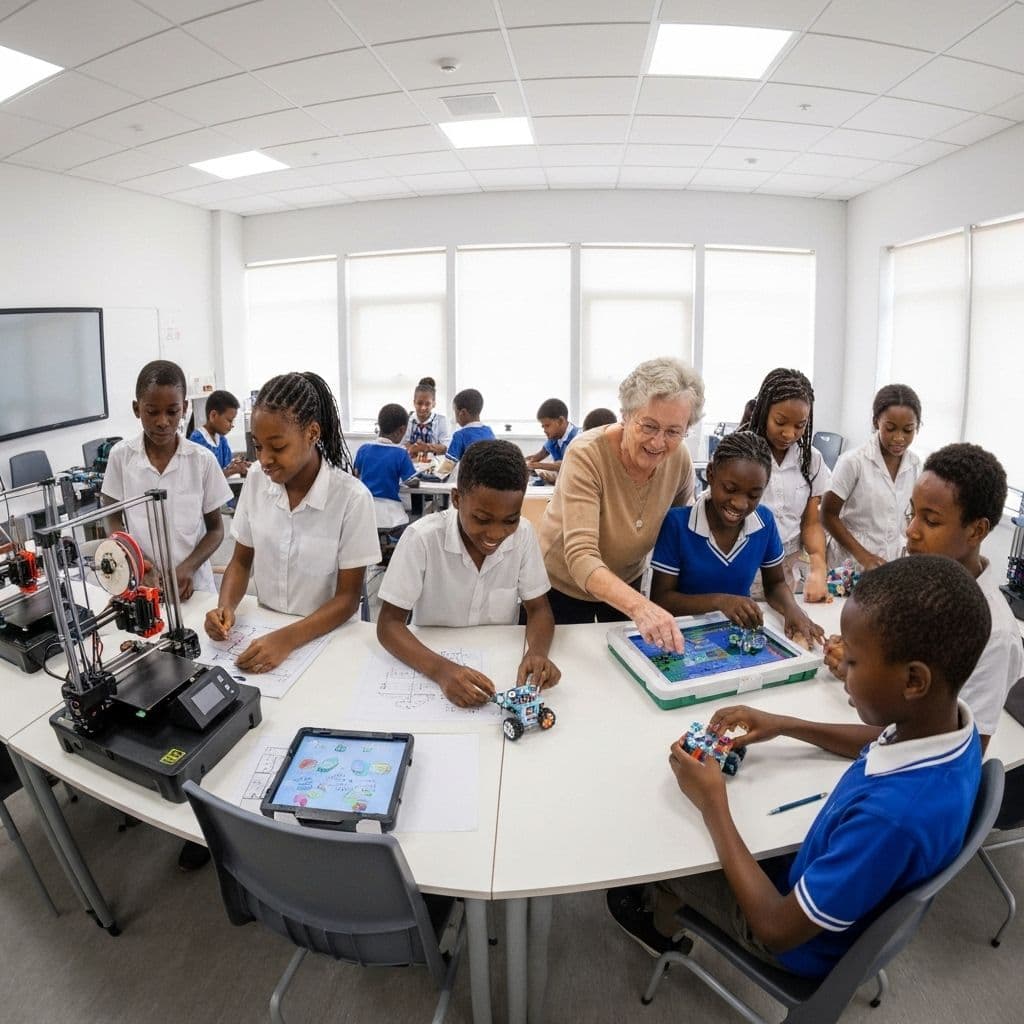
The central idea
Sequence robotics from embodied logic and mechanisms toward sensing, feedback, autonomy and responsible system design.
Editorial evidence note
This article provides professional educational guidance. Any illustrative school situation is hypothetical unless a named external source is supplied.
A practical Ghanaian school scenario
A school team facing this decision could begin with one learner group and one term. The team would define the intended capability, document current constraints, test the approach represented by “Ages 6–9: sequence, cause and effect, structure and simple machines”, and review learner work with teachers before expanding. The scenario is intentionally hypothetical so that schools can adapt it without mistaking it for a reported InovTech outcome.
The decision beneath the headline
For curriculum leaders, teachers and parents, this question has consequences far beyond a single lesson or purchase. When every age group repeats the same build-and-drive activity, excitement may remain high while technical progression remains flat.
Sequence robotics from embodied logic and mechanisms toward sensing, feedback, autonomy and responsible system design. That standard helps institutions distinguish visible activity from durable educational value.
Ages 6–9: sequence, cause and effect, structure and simple machines
Implementation often fails at the handover between a good idea and ordinary school routines. Ages 6–9: sequence, cause and effect, structure and simple machines must therefore appear in lesson preparation, role descriptions, budgets and review meetings—not only in the programme proposal.
Use “Map a multi-year progression” as an ownership test: identify who acts, by when, with which resources, and what happens if the assumption proves wrong. Clear ownership protects both quality and trust.
Ages 10–13: sensors, loops, variables, measurement and debugging
Equity changes the meaning of ages 10–13: sensors, loops, variables, measurement and debugging. Ask who receives meaningful technical time, who is asked to document rather than build, whose language or disability creates friction, and whether the design quietly rewards learners who already have access.
The action “Define evidence at every stage” should be reviewed with learner and teacher voice. Participation figures alone cannot show whether people experienced belonging, intellectual challenge and genuine responsibility.
Ages 14–18: control systems, data, text coding and optimisation
Evidence should shape ages 14–18: control systems, data, text coding and optimisation from the beginning. Define a baseline, preserve learner artefacts, observe the quality of reasoning and decide which result would trigger adaptation rather than expansion.
When teams “Balance physical and virtual robotics”, they should document both the result and the conditions that produced it. That discipline prevents a successful demonstration from being mistaken for a sustainable programme.
At every age: documentation, teamwork and explanation
“At every age: documentation, teamwork and explanation” should be translated into a visible decision, not left as an aspiration. For curriculum leaders, teachers and parents, that means naming the learner behaviour, adult responsibility, resource requirement and evidence that would show the decision is working.
A useful stress test is to attempt “Train teachers one level ahead” with the smallest realistic group. Record where time, confidence, access or coordination breaks down; those observations are design evidence, not reasons to abandon the ambition.
Assess transfer through unfamiliar problems, not copied builds
The case for assess transfer through unfamiliar problems, not copied builds becomes stronger when teams separate educational necessity from attractive extras. Begin with what learners must understand or perform, then work backward to tools, staffing and timetable.
In practice, “End each cycle with a purposeful design challenge” creates an early checkpoint. It gives leaders something concrete to examine before scale makes weaknesses expensive or difficult to reverse.
A disciplined implementation sequence
Begin with the smallest version that can still test the central claim: sequence robotics from embodied logic and mechanisms toward sensing, feedback, autonomy and responsible system design. Protect time for preparation, observe what participants actually do and review evidence before adding more learners, locations or technology.
The sequence below converts the argument into accountable work. It is intentionally concise so a school or programme team can assign owners and dates during one planning meeting.
- Map a multi-year progression
- Define evidence at every stage
- Balance physical and virtual robotics
- Train teachers one level ahead
- End each cycle with a purposeful design challenge
Frequently asked questions
What is the most important starting point for robotics education?
Begin with a clearly defined learner or institutional outcome, then assess people, time, infrastructure and evidence before choosing tools.
How can a school apply this guidance?
Start with a contained pilot, use the article’s action checklist, collect evidence from learners and teachers, and improve the model before scaling.
Put the article into practice
- 1Map a multi-year progression
- 2Define evidence at every stage
- 3Balance physical and virtual robotics
- 4Train teachers one level ahead
- 5End each cycle with a purposeful design challenge