The Secret to Scaling STEM Education Is Not More Content. It Is Stronger Teachers.
Africa cannot workshop its way to lasting STEM transformation. Teacher development must become an ongoing cycle of practice, evidence, coaching and leadership.
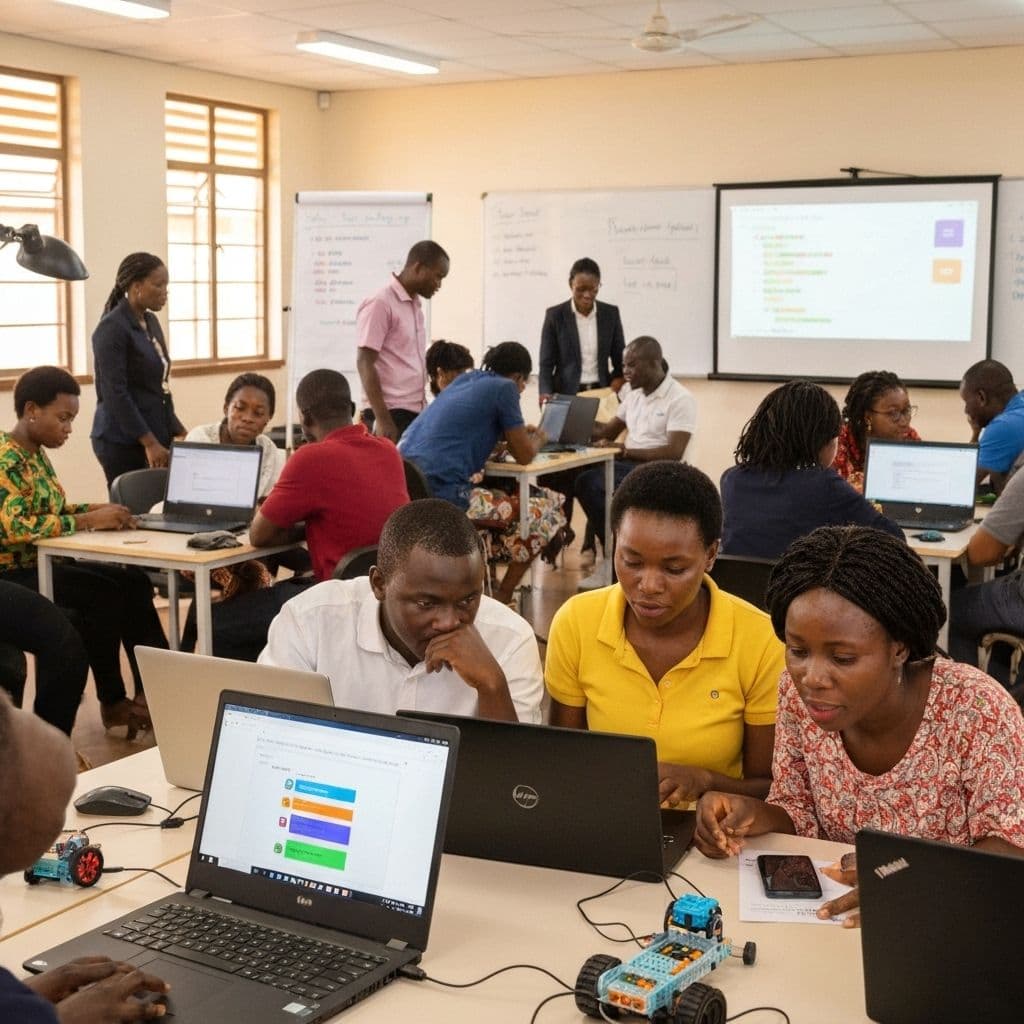
The central idea
Sustainable STEM growth depends on educators who can facilitate inquiry, diagnose learner thinking and confidently adapt tools to their context.
Why one-off workshops disappoint
A workshop can inspire teachers, introduce tools and build initial confidence. It cannot, by itself, change months of classroom practice. Transfer happens when teachers rehearse, teach, examine evidence, receive feedback and try again.
Professional development should therefore be designed as a learning journey, not an event. The same principles we value for students—practice, iteration and reflection—must apply to adults.
From expert performer to expert facilitator
The STEM teacher does not need to know every answer before learners begin. The teacher needs to create productive conditions: a clear challenge, accessible materials, purposeful questions, safe boundaries and criteria that make quality visible.
This role can feel unfamiliar in systems shaped by explanation and recall. Coaching helps teachers resist the urge to solve every problem and instead guide learners to test their own thinking.
- Model the activity
- Rehearse facilitation
- Teach in context
- Collect learner evidence
- Reflect with a coach
- Adapt and repeat
Technical confidence and pedagogical judgment must grow together
Knowing how to assemble a robot is not the same as knowing how to teach with it. Conversely, strong pedagogy cannot compensate indefinitely for fear of the tools. Effective development interweaves technical practice, lesson design, assessment, inclusion and troubleshooting.
Build leadership around the teacher
Even an excellent teacher struggles when the timetable, class size, storage or assessment system works against practical learning. School leaders need their own implementation support so that teacher effort is reinforced by policy and resources.
InovTech’s teacher-development approach connects training to the actual programme environment. The goal is independent capability: educators who can run, improve and eventually lead high-quality STEM learning within their institutions.
Scale quality, not just reach
The number of teachers trained is easy to report. The stronger question is what changed in classrooms. Did learners ask better questions? Did teachers use evidence differently? Were girls and quieter learners given meaningful technical roles? Did projects become more rigorous? Scale is valuable only when quality travels with it.
Frequently asked questions
What should effective STEM teacher training include?
It should combine technical skills, hands-on pedagogy, assessment, inclusion, safety, classroom rehearsal, coaching and follow-up evidence.
How can schools know whether teacher training worked?
Observe classroom practice and learner evidence over time rather than relying only on attendance or post-workshop satisfaction.